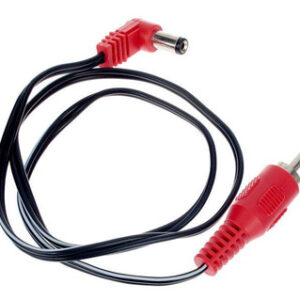
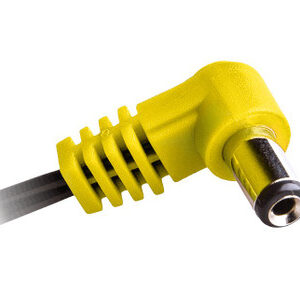
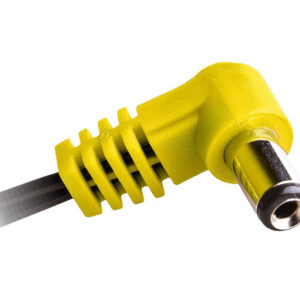
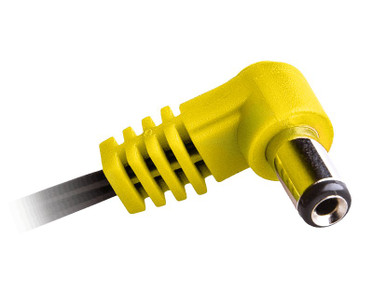
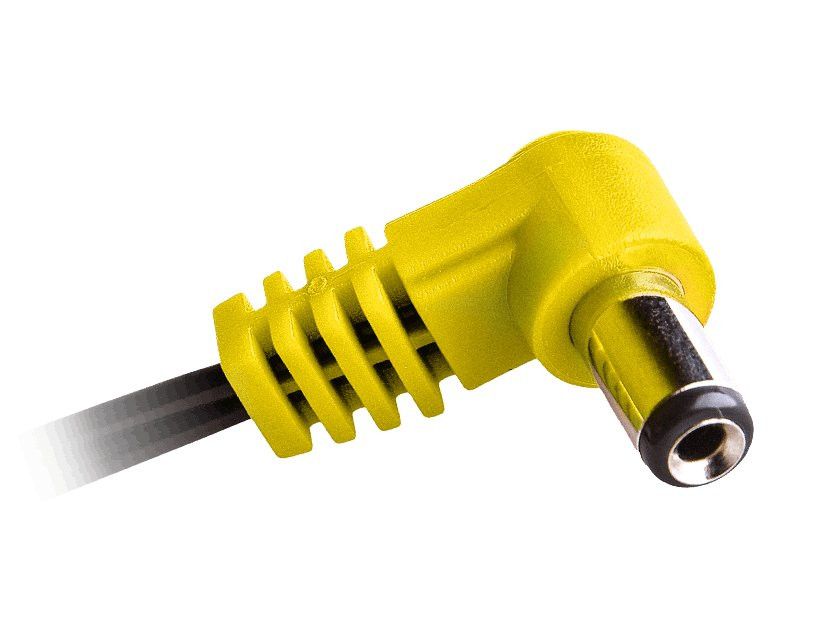
Cioks Flex Cable Type 3 Yellow Plug 50cm

£3.99

This is a New Cioks Flex Cable Type 3 Yellow Plug 50cm from Cioks is in our Specialist Effects Pedals category on Just Pedals. Read More below.

View Just
more

Here's What Cioks Say About the Type 3 Cable

Type 3 Flex cable is yellow and fitted with a centre negative 5,5/2,5mm DC plug. This is the cable you need if you want to power a Line6 Stomp from the CIOKS DC7 – simply combine this Flex cable with the Parallel Adapter Flex and you are good to go.

Apart from the Line6 Stomp pedals, this type of plug is very rarely seen with pedals. Three pedals we know use this standard and these are T-Rex Spindoctor, Line 6 AMPLIFi FX100 and Digitech JamMan Solo XT where the last one is not even for sure. JamMan Solo XT needs for sure a centre negative DC plug but we had a client who couldn’t fit in the standatd 5,5/2,1mm plug so we’ve made this yellow one with same standard BOSS polarity but for the larger 2,5mm pin. It’s only avaliable with angled (L-shaped) plug and only in 50cm length.

If you have green Flex cables to supply say your Eventides with 12V DC and would like to use another colour for an AC pedal which also has a 2,5 pin socket you can use this cable so you can distinguish them. With AC pedal the polarity doesn’t matter.
Related videos

Brand

Cioks

CIOKS is a Danish company founded by Poul Ciok in 1991, with a catalogue devoted to power for effects pedals. Its early five-output Baby supply established the focus on dependable pedalboard power; the current range adds low-profile isolated supplies and modular expanders. JustPedals listings include DC7, CIOKS 4, SOL and CRUX, plus mounting brackets and accessories. DC7 can power a range of analogue and high-current digital devices and expand through additional units, so outlet isolation, current draw and voltage options are the useful comparison points. CIOKS documentation says DC7 is designed in Denmark and assembled in Poland; that detail applies to DC7, not every product.

Category

Specialist Effects Pedals

Specialist effects alter the signal in ways that do not sit cleanly inside one established family. They may use granular processing, frequency shifting, resonators, freeze or sustain, bit reduction, ring modulation, feedback networks or combinations of several techniques. The relevant distinction is the underlying process, its tracking or latency, and how completely the dry signal can be blended or replaced.