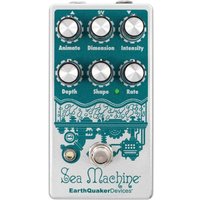
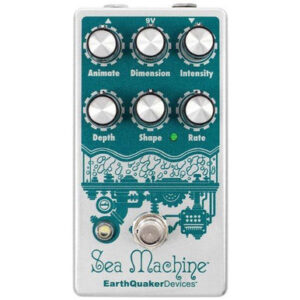
The EarthQuaker Devices Sea Machine V3 Chorus is an incredible pedal with improved circuitry an extended control range and silent relay-based switching. Thanks to these features you are provided with an enhanced performance clearer sounds and low noise operation. The third iteration of the Sea Machine still offers an incredible range of modulation options. From a subtle and shimmery chorus to a wobbly and seasick pitch bends ensuring this model stands apart from most other chorus pedals. It also comes equipped with a hybrid of digital and analogue circuitry working well following fuzz overdrive and distortion pedals. With its wide variety of controls you are able to adjust the short digital delay line and set the LFO. Never be short of inspiration with the Sea Machine V3.
EarthQuaker Devices Sea Machine V3 Chorus
This is a New EarthQuaker Devices Sea Machine V3 Chorus from EarthQuaker Devices is in our Chorus Pedals category on Just Pedals. Read More below.
As an affiliate partner, we may earn a small commission when you buy through our links — at no extra cost to you.
Related videos
Brand
EarthQuaker Devices
Musician Jamie Stillman founded EarthQuaker Devices in 2004 after moving from pedal repair into circuit design. The first full-production release was the Hoof fuzz in 2007. The company develops its pedals in-house in Akron, Ohio, where it hand-builds and hand-tests them and backs them with a lifetime guarantee. Current JustPedals examples show the range’s practical and exploratory sides: Ghost Echo reverb, Data Corrupter harmonizer, Avalanche Run delay and reverb, and Rainbow Machine pitch shifting. EarthQuaker’s own design philosophy pairs usable controls with sounds that can move well beyond conventional effects.
Category
Chorus Pedals
Chorus mixes the dry signal with one or more short, continuously modulated delays. The small pitch and timing movement between the paths creates width, shimmer and the impression of several instruments playing together. Rate controls the modulation speed, depth controls its excursion, and delay or mix settings determine whether the result is subtle thickening, a liquid wobble or a broad stereo image.
Tags
Analogue
The signal is shaped by continuously varying electronic circuitry rather than being converted into a digital effect algorithm. Component choice, operating voltage and circuit tolerances influence headroom, noise, clipping texture and the small variations in response between designs.
Digital
Converts the signal or control process into numerical data for algorithmic processing. Digital designs can provide precise timing, long memory, complex routing and repeatable presets; sample rate, conversion, internal resolution and latency influence fidelity and response.
Hybrid
Combines analogue and digital stages within one signal or control design. A digital section may provide memory, routing or modelling while analogue circuitry supplies clipping, filtering or amplification, so the order and blend of the two domains shape the final response.
Others Just Ordered :
- Mooer Meta FX – Review
- MOOER META FX Review: 3 Effects in 1—but Here’s the Problem

- I Wasn’t Expecting To Be Impressed – But What Is The Mooer Meta FX?

- Mooer // META FX Stereo Multi-Effect Platform (Demo)
- A NEW GENERATION OF PEDALS IS HERE – Mooer Meta FX Reverb Review

- Mooer META FX | All the REVERBS from subtle to WILD!