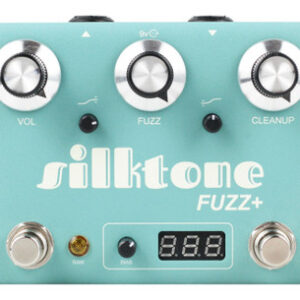

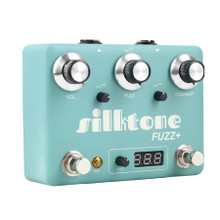
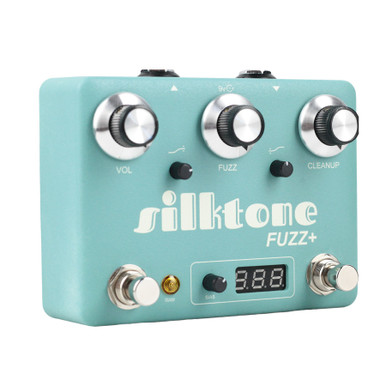
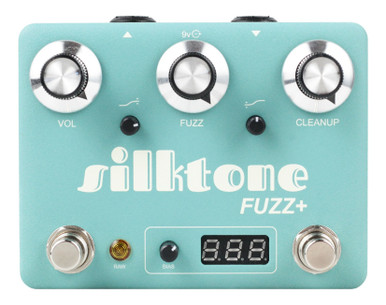
This is what Silktone say about the Silktone Germanium Fuzz Plus Pedal in Teal:
The Silktone Fuzz has been updated with some cool new features starting with a couple of tone controls to subtly shape the sound of the fuzz. The tone controls are a product of the cleanup circuit so they shape the tone before heading into the fuzz. The bass shape goes from a tight and forward sound when turned down to full and round when turned up. The treble shape subtly rolls off the high end for a softer fuzz tone. The shaping is much more apparent at cleaner settings too.
The next (and most fun) addition is the second footswitch which engages RAW mode bypassing the tone controls and the cleanup knob to bring you back to full raw fuzz. This makes it a sort of dual fuzz to get a huge variety of sounds.
The taper of the “Cleanup” control is much smoother compared to the old version and the “Fuzz” control is much more usable now too allowing you to set post gain and shape the sound a bit or to set max fuzz level when cleanup is bypassed in raw mode. The Fuzz+ also has way higher output volume than the original fuzz so it can be used to hit your amp harder whether in full fuzz or when cleaned up as a colorful germanium boost.
The power supply has been updated so the Fuzz+ can accept any 9V power source (center negative) and can be daisy chained with other pedals. An isolated power supply is no longer required.
The Fuzz+ still has a pickup simulator so it can be placed anywhere in the chain without worrying about buffers
The bias control also works a lot better than before at the extreme ranges allowing you to fine tune the bias voltage of the germanium transistors regardless of temperature shifts that normally plague this style of circuit.
At the heart of the Silktone Fuzz+ are two germanium transistors in the classic fuzz face topology, tweaked to get a huge array of tones and fix all the annoyances you get with a typical germanium fuzz. We wanted to nail the awesome tones everybody knows and loves when these transistors are biased to their sweet spot… and also when they’re not. With our bias control you can easily hit them all.
What’s up with that “CLEANUP” knob?
It cleans up the fuzz the higher you push the knob – it works in turn with the pickup sim by mimicking your guitar volume knob to get the cleaner sparkly boost/light overdrive tones a good germanium fuzz face is known for when you roll your guitar volume knob back a bit.
Why does it have a “pickup simulator”?
A lot of fuzzes have really low input impedance so when you put a high impedance guitar in front of them it creates this really nice high-mid hump and roll-off keeping things relatively tame and musical. If you place a buffer or any other pedal with a low output impedance before a typical low impedance fuzz you get this really nasty squealing oscillation and lose all musicality and nuance – if you’ve ever tried placing a buffered tube screamer or wah before a fuzz you’ll know this well. The silktone fuzz fixes this with an onboard pickup simulator so you can place the pedal anywhere in the chain and it behaves as if a guitar is plugged straight into it. I really like it after a cocked back wah for some cool Q filtering.
What is “BIAS”?
Bias is the operating voltage of the transistors, determining how they distort and clip the audio signal. There are a couple common ways most builders approach adjustable bias in a fuzz face circuit, one way is to make both transistors adjustable – things can get messy really easily this way because the transistors interact with each other and that first transistor is really sensitive to changes – it becomes hard to nail down consistently good tones, especially with temperature sensitive germanium… The other way (I’ve seen done most) is making only the second transistor adjustable – there’s less tonal range this way but it behaves better unless, again, it’s germanium and gets thrown off by temperature – then there’s no correction in place for the first transistor so it can get all out of whack.
We do it a little different than either of these methods, the cool thing about the fuzz face circuit is that the two transistors are directly coupled so if you change the values around one it affects the other automatically, we use this to our advantage and carefully bias things internally to make both transistors land where they need to be and enable the external bias control to have a huge range of easily accessed tones that all sound great for what they are and can be recalled any time (or temperature) without trouble.
- BIAS points
- Gated: 1.10 volts (works exceptionally better in raw mode)
- Sweet: 4.50 volts
- Fat: 6.50 volts
- Sticky: 7.50 volts
Why an LED bias meter?
With germanium fuzz being so temperature sensitive even bias knob adjustments on other pedals become completely pointless with big temperature swings – leaving you to set by ear every time which isn’t always easy. If all you have is a traditional bias knob with no read-out and you have it set to 10 o’ clock or so in a 70 degree room and it sounds great – and then go play outdoors in 90 degree weather or go down to the basement and it’s 50 degrees – your 10 o’ clock position from before will sound completely different, probably causing a gating effect or something and you’ll have to find the new spot you like every time. This was always a pain in the ass to me. The active bias monitor on the silktone fuzz takes out any guess work, you just remember the number you like for whatever tone you’re after and if the temperature shifts too much the meter will reflect that so you can quickly and easily dial it right back where you like it and forget about it. You don’t have to shift it all the time or anything – just with big temperature swings… plus it doubles as an on/off indicator and looks really cool.