
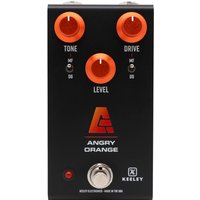
The Keeley Angry Orange Distortion and Fuzz is perfect for guitarists looking to blend classic and new distortion tones into their setup. With two legendary circuits – the Japanese distortion from the 70s and a classic Soviet fuzz – this pedal lets you experiment with both while offering two all-new hybrid tones for even more creative control. The Angry Orange features a simple three-knob layout and allows you to easily switch between Buffered and True Bypass for flexible rig setups. Whether youre after hard-hitting distortion or soft vintage fuzz this pedal offers it all in an all-analog format delivering rich saturated sounds without compromising on quality. Manufactured in the USA its built to withstand the demands of professional use.
Keeley Angry Orange Distortion and Fuzz
£192.50
This is a New Keeley Angry Orange Distortion and Fuzz from Keeley Electronics is in our Distortion Pedals category on Just Pedals. Read More below.
View Just Keeley Electronics
As an affiliate partner, we may earn a small commission when you buy through our links — at no extra cost to you.
Related videos

Brand
Keeley Electronics
Robert Keeley began by modifying effects for guitarists and built the first Keeley Compressor while pursuing more useful control over dynamics and sustain. The Oklahoma City company now designs, builds, tests and refines its effects there, with a range spanning compression, overdrive, fuzz, pitch, delay and reverb. The Compressor remains its best-known family. JustPedals listings also include the Mk3 Driver, Octa Psi pitch shifter and fuzz, Manis overdrive and Nocturne reverb. Keeley’s work often adds practical controls to familiar circuit ideas, such as pickup-sensitive release settings on its compressor pedals.
Category
Distortion Pedals
Distortion clips the waveform more firmly than overdrive, generating dense upper harmonics, longer sustain and a more compressed response. Circuit topology and filtering decide whether the sound is tight and focused, broad and aggressive, smooth or deliberately abrasive. Gain sets the amount of clipping, while pre- and post-distortion tone controls strongly influence low-end definition, midrange presence and high-frequency texture.
Tags
Analogue
The signal is shaped by continuously varying electronic circuitry rather than being converted into a digital effect algorithm. Component choice, operating voltage and circuit tolerances influence headroom, noise, clipping texture and the small variations in response between designs.
Fuzz
Pushes the signal into extreme clipping, often approaching a square wave and producing dense harmonics. Transistor type, bias, input loading and filtering govern whether the texture is smooth, woolly, gated, spluttering, octave-rich or highly responsive to the instrument volume.
Hybrid
Combines analogue and digital stages within one signal or control design. A digital section may provide memory, routing or modelling while analogue circuitry supplies clipping, filtering or amplification, so the order and blend of the two domains shape the final response.
True Bypass
Connects input directly to output through mechanical or relay switching when the effect is off, removing the active circuit from the audio path. It avoids buffer colour but leaves cable capacitance and switching design to influence high-frequency loss and possible switching noise.
Others Just Ordered :
- I Love A Happy Accident… – Animals Pedal

- Animals Pedal Vintage Van Driving is Very Fun Overdrive

- Animals Pedal Sunday Afternoon Is Infinity Bender

- Ninevolt Pedals | Bath Time Reverb (Animals Pedal)

- This Fuzz Pedal Makes No Sense… But It Sounds Incredible

- ANIME Pedals | Animals Pedal Custom Illustrated Series