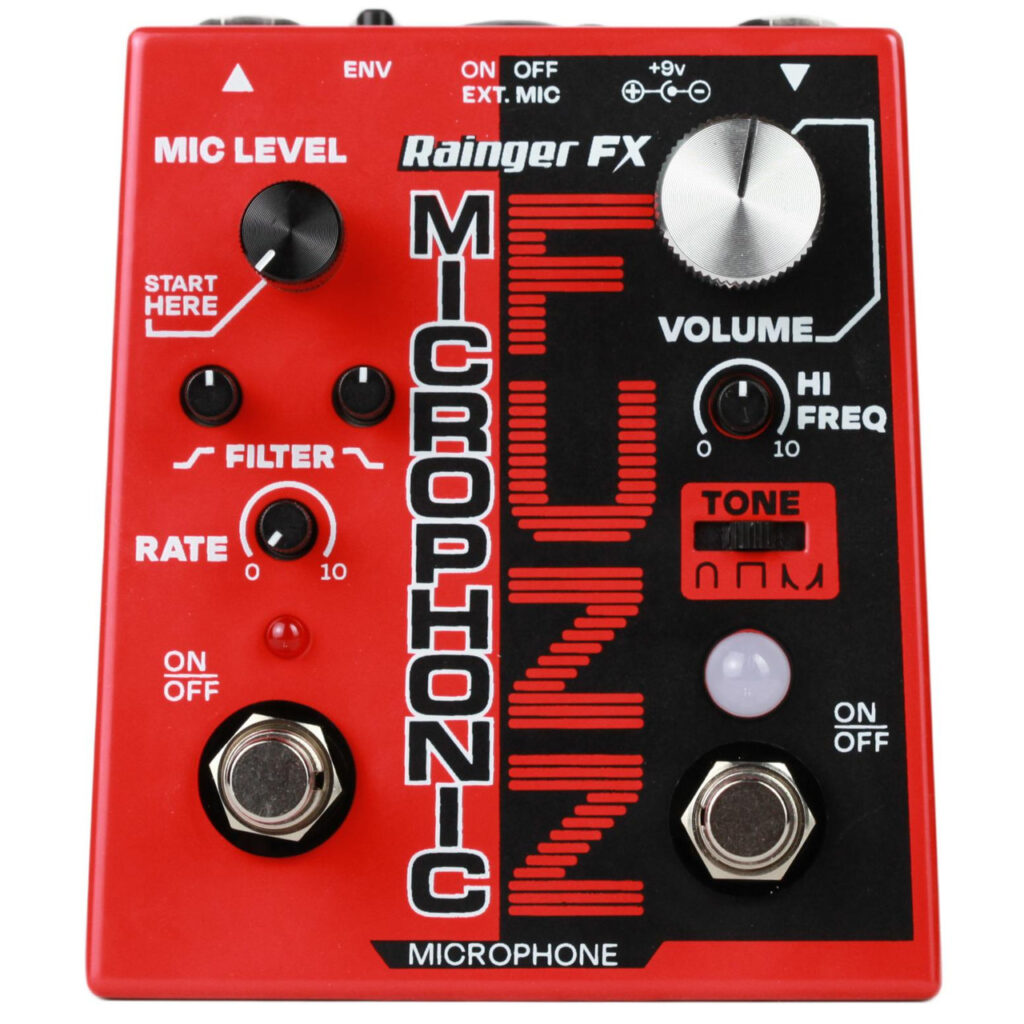



The Rainger FX Microphonic Fuzz is one of the most inventive fuzz pedals we’ve seen in a while. At its heart is a high-gain analogue fuzz circuit, but the real magic comes from a built-in microphone that can be blended in or switched out entirely. The result? Everything from a straightforward, aggressive fuzz tone to unpredictable, room-filling textures that react to the environment around you. High-gain fuzz with multiple voices Even with the mic disengaged, the Microphonic Fuzz is a super versatile gain machine. It delivers plenty of saturation without feeling overly gated or saggy, and it responds surprisingly well to your guitar’s volume control. A three-way tone switch lets you jump between very different voicings, from a mid-focused punch to ultra-scooped modern tones, while the Hi Freq control makes it easy to dial in the perfect amount of top-end bite. Built-in mic Switch in the internal microphone and things get wonderfully strange. Mounted inside the enclosure, it captures the sound of your amp and the room around it, feeding that ambience back into the effect for a bigger, more alive feel. Dedicated high-pass and low-pass filters help shape the response, while adjustable mic level controls let you push the pedal from subtle spatial thickening to controlled feedback experiments that can be tuned around specific frequencies and notes. Experiment, explore & get weird The Microphonic Fuzz rewards curiosity. A dedicated Rate control adds chopped tremolo to the microphone signal, while subtle modulation helps keep feedback textures moving and musical. Rotate the pedal, change its position in the room, connect an external microphone, or even sing directly into it for wild results!Key Features Innovative microphonic circuit: A built-in microphone can be switched in or out, letting you move from a conventional high-gain fuzz sound to immersive, room-reactive textures that make your rig feel bigger, livelier and totally unique. Versatile high-gain fuzz engine: Rainger FX’s custom analogue fuzz circuit delivers rich saturation with excellent clean-up from your guitar’s volume control, while multiple tone voicings help you dial in a variety of tones. Advanced feedback & ambience shaping: Dedicated high-pass and low-pass filters, along with adjustable mic level controls, allow you to sculpt feedback and ambience with surprising precision. Built for sonic experimentation: Add chopped tremolo to the microphone signal, reposition the pedal to alter its response, connect an external microphone, or even sing through it. The Microphonic Fuzz is a creative sound-design tool! Specifications Power: 9V (Centre-Negative) Current Draw: 86 mA True Bypass: Yes Dimensions (D x W x H): 119 x 102 x 59 mm



Rainger FX Microphonic Fuzz Pedal
This is a New Rainger FX Microphonic Fuzz Pedal from Rainger FX its found in our Fuzz Pedals on the Just Pedals menu. Read More below.
As an affiliate partner, we may earn a small commission when you buy through our links — at no extra cost to you.
Brand
Rainger FX
In the current JustPedals catalogue, Rainger FX is represented by Delay Pedals, Distortion Pedals and Overdrive Pedals. Current listings include Razor Fuzz, Echo-X Delay and Snare Trap – Beatbox. That makes the range relevant to players looking for drive, gain and clipping, plus time-based effects and ambience. Check each model for its exact circuit or processing platform, controls, power requirements and connections, particularly where the catalogue includes both pedals and supporting gear.
Category
Fuzz Pedals
Fuzz drives the signal into extreme clipping, often flattening the waveform and generating a thick spectrum of harmonics. Transistor type, bias, input loading and tone filtering create markedly different responses, from loose and velvety to gated, spluttering or octave-rich. Some circuits interact strongly with pickup impedance and guitar volume, while others include buffers or blends for a more consistent response.
Tags
Analogue
The signal is shaped by continuously varying electronic circuitry rather than being converted into a digital effect algorithm. Component choice, operating voltage and circuit tolerances influence headroom, noise, clipping texture and the small variations in response between designs.