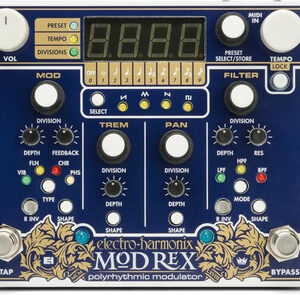
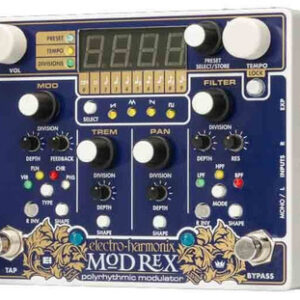
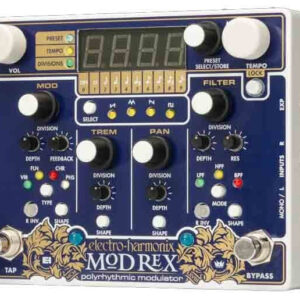
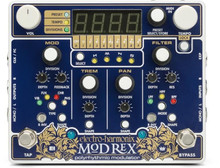
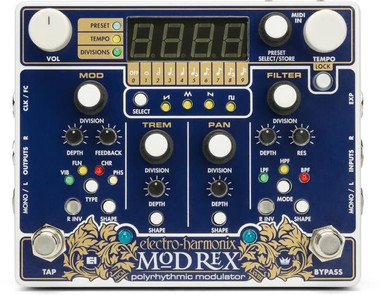
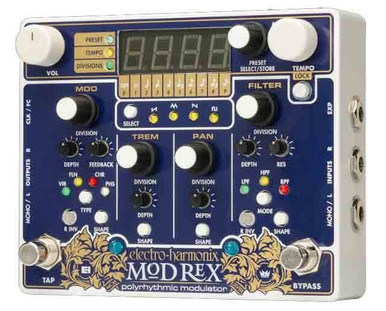
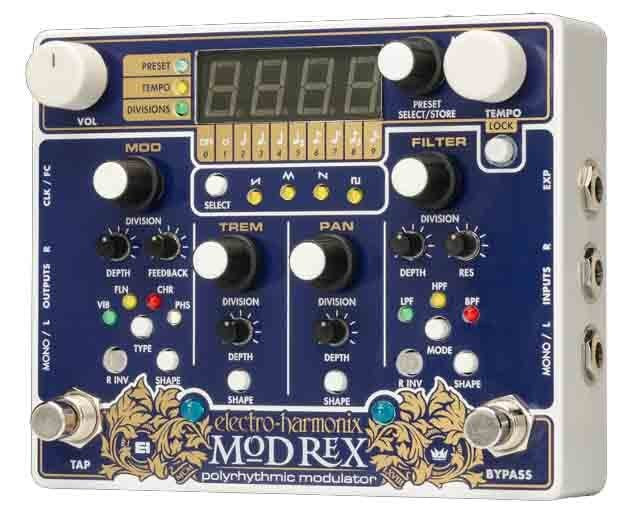
Electro Harmonix Mod Rex Poly-Rhythmic Modulator Pedal

Retailing in the region of £289.00

On the menu for January 2026 are the Electro Harmonix Guitar Pedals, freshly added and carefully selected. These New units are available to order online with fast, secure delivery from trusted UK retailers. Read on for full details, specifications, demos, videos, reviews, and the best places to buy the Electro Harmonix Guitar Pedals today.


Spread the love

Description

Spread the love

On the menu for January 2026 are the Electro Harmonix Guitar Pedals, freshly added and carefully selected. These New units are available to order online with fast, secure delivery from trusted UK retailers. Read on for full details, specifications, demos, videos, reviews, and the best places to buy the Electro Harmonix Guitar Pedals today.

The Electro Harmonix Mod Rex is the ultimate mix-and-match modulation pedal. Use this all-encompassing stompbox with synth or guitar to produce the most diverse polyrhythms imaginable. 

It boasts four independent modulation engines able to sync together or work separately, so you have complete control over your sound. This is the perfect pedal for experimental musicians thanks to a huge amount of controllable parameters. 

Modulations

The four engines consist of Mod, Trem, Pan and Filter. Select from chorus, phaser, flanger or vibrato effects under the Mod section to shape your base modulation. These are all controlled with depth, feedback and shape dials. However the most interesting is the R. Invert, which doubles the effect for a stereo simulation.  

Move onto the Trem and Pan settings to vary the tempo and strength of pulses, or the focus of sound. These are incredibly tone-defining when used with a synth and all-out crazy applied to a guitar. These settings add a studio quality sound to recordings. The filter on the right side of the pedal changes your perception of the effects. Go from an auto-wah type sound all the way over to a lo-fi funnelling.

Sync and subdivide all of the Mod Rex’s engines to a master tempo. Or each individual effect can be assigned to one of nine subdivision tempos. Use an expression pedal to further control the modulation rate. Go even deeper and explore all four LFO shapes assignable to effects. No one setting will ever sound the same.    

Intuitive design

Save up to a massive 100 presets, so you’ll never forget an effect. Recall the presets easily using the digital display. Simply turn the preset dial to select an effect on the fly. 

The Mod Rex is fully MIDI compatible which is great when working with drum machines and synths. Sync up using a pulse clock so you can let everything play out in front of you, leaving your hands free to change sounds. The tap tempo feature lets you tap your foot along to the beat, keeping the Mod Rex dynamically in time with what you’re playing. All modulations and LFO can adapt without hard resetting. Settings with tempo divisions bigger than or uneven with a quarter note will seamlessly stay in time.

Specifications

  • Up to four simultaneous modulation sections synced in time.
  • MOD section offers a choice of Vibrato, Flanger, Chorus or Phaser
  • Standalone Tremolo, Modulated Panning and Modulated Filter sections.
  • 9 tempo subdivision options for each modulation section.
  • 4 LFO shape options for each modulation section
  • 100 storable presets
  • Full stereo input and output
  • Tap Tempo and Tempo Sync to an external device with MIDI Clock or an external pulse clock
  • Full MIDI control of all parameters and recalling of presets
  • External expression pedal input
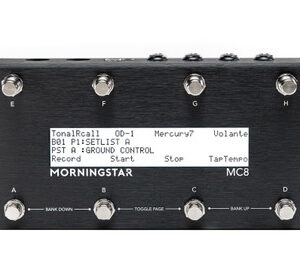
  • External foot controller input to bank presets up and down
  • 9.6VDC/200mA power supply included
  • Dimensions in inches: 4.75 (w) x 5.75 (l) x 2.5 (h)
  • Dimensions in mm: 146 (w) x 121 (l) x 64 (h)
Additional information

Weight 0.5 kg

Brand

Electro Harmonix

Electro-Harmonix (EHX) is a legendary manufacturer of guitar pedals and audio electronics, renowned for their distinctive sound and pioneering designs. Established in 1968 by Mike Matthews, EHX has played a significant role in shaping the landscape of effects pedals. The company’s pedals are celebrated for their innovative circuits and unique tones, earning them a dedicated following among musicians across genres. From classics like the Big Muff Pi fuzz to modern favorites like the POG octave generator, Electro-Harmonix pedals are known for their versatility and sonic character.

EHX’s product lineup spans a wide range of effects categories, including distortion, modulation, delay, and reverb, among others. Their pedals often feature intuitive controls and rugged construction, making them suitable for both stage and studio use. In addition to their iconic standalone pedals, Electro-Harmonix has also produced notable units such as the Memory Man delay/echo and the Holy Grail reverb, which have become staples in many guitarist’s rigs. With a legacy of innovation and a commitment to quality, Electro-Harmonix continues to be a leading force in the world of guitar effects, inspiring musicians to explore new sonic possibilities.

Category

Guitar Pedals

Tags

Chorus

Expression

Expression pedals allow real-time control over specific parameters on compatible guitar pedals, such as volume, delay time, modulation depth, or filter sweep. Used with an expression input, they let players shape effects dynamically with their foot, adding movement and performance control that cannot be achieved with fixed knob settings.

Filter

Flanger

A flanger is a type of guitar effects pedal used to create a swirling, whooshing sound by modulating the phase of an audio signal. It works by combining the original signal with a slightly delayed and modulated version of itself. As the two signals interact, they create peaks and troughs in the frequency spectrum, resulting in the characteristic “jet plane” or “swooshing” sound associated with flanging.

Key features of a flanger pedal include:

1. **Rate**: Controls the speed at which the delayed signal is modulated. Higher rates produce faster modulation, while lower rates create slower, more subtle effects.

2. **Depth**: Adjusts the intensity of the modulation effect. Higher depth settings result in more pronounced sweeps, while lower settings produce a gentler effect.

3. **Manual (or Range)**: Sets the center frequency of the modulation. This control allows you to focus the effect on specific frequency ranges, altering the tonal character of the flanging.

4. **Feedback (or Regeneration)**: Determines the amount of modulated signal that is fed back into the effect. Increasing feedback can create more pronounced peaks and troughs, resulting in a more intense effect.

Flanger pedals are commonly used in various music genres, including rock, metal, and psychedelic music, to add movement, depth, and texture to guitar tones. They can be used subtly to add a touch of modulation and dimension to a guitar sound, or more prominently to create dramatic swirling effects. Overall, flanger pedals offer guitarists a versatile tool for shaping and enhancing their tone, adding a dynamic and expressive element to their playing.

MIDI

MIDI pedals use the Musical Instrument Digital Interface standard to communicate with other guitar pedals, effects units, and hardware. They allow control over presets, parameters, and switching across multiple devices from a single controller. MIDI integration makes it possible to build complex, synchronised pedal setups while keeping control simple and consistent.

New

This is brand new, fresh in, and a UK warranty is included. New Gear always comes from trusted UK music retailers.

Phaser

A phaser is a type of guitar effects pedal that creates a swirling, sweeping sound by modulating the phase of the audio signal. It works by splitting the incoming signal into two paths, shifting the phase of one path, and then recombining them. This creates peaks and troughs in the frequency spectrum, resulting in a distinctive, “phasing” effect characterized by moving notches in the frequency response.

Here’s how a phaser pedal typically works and some common features:

1. **Rate**: The rate control adjusts the speed at which the phase-shifting effect oscillates. Increasing the rate produces faster modulation, creating a more pronounced swirling effect, while decreasing the rate slows down the modulation for a smoother, more subtle effect.

2. **Depth**: The depth control adjusts the intensity or depth of the phase-shifting effect. Higher depth settings result in more pronounced peaks and troughs in the frequency response, while lower settings produce a more subtle modulation.

3. **Feedback (or Regeneration)**: Some phaser pedals feature a feedback control that determines the amount of modulated signal fed back into the effect. Increasing the feedback creates more pronounced peaks and troughs in the frequency spectrum, resulting in a more intense and resonant phasing effect.

4. **Stages**: Phasers typically have multiple stages (usually four, six, or eight), each of which contributes to the overall phase-shifting effect. More stages generally result in a more complex and textured phasing sound.

5. **Sweep (or Manual)**: The sweep control adjusts the center frequency of the phase-shifting effect. This allows you to focus the phasing effect on specific frequency ranges, altering the tonal character of the modulation.

6. **Resonance (or Feedback)**: Some phaser pedals feature a resonance control that emphasizes the peaks and troughs in the frequency response, creating a more pronounced and resonant effect. This control can add richness and depth to the phasing sound.

Phaser pedals are commonly used in various music genres, including rock, funk, and psychedelic music, to add movement, depth, and texture to guitar tones. They can be used to create swirling, swirling effects on rhythm parts, add dynamics to lead lines, or create atmospheric textures for ambient music. Overall, phaser pedals offer guitarists a versatile tool for shaping their tone and adding expressive modulation effects to their playing.

Tremolo

A tremolo pedal modulates the volume of your guitar signal up and down in a rhythmic pattern, creating a pulsing or wavering effect that can sound vintage and hypnotic or sharp and choppy depending on the settings. It’s one of the oldest effects in guitar history, famously used on classic amps from the 1950s and ’60s.

Most tremolo pedals let you control the speed, depth, and wave shape, allowing you to go from smooth, subtle swells to intense stuttering tones. It’s a simple but expressive effect that adds movement and character to your sound.

used

Vibrato

Vibrato refers to a guitar pedal effect that modulates pitch slightly up and down, creating movement and a sense of wobble in the sound. Unlike tremolo, which changes volume, vibrato affects pitch only, producing anything from subtle shimmer to pronounced, warbling textures. It is often used to add character, depth, and vintage-style modulation to guitar tones.

Wah

Wah refers to an expressive filter effect that sweeps through a range of frequencies, creating a vocal-like “wah” sound. Controlled in real time with a foot-operated treadle, it allows players to emphasise different parts of the frequency spectrum as they play. Wah pedals are commonly used for lead guitar, funk rhythm work, and expressive solos, responding closely to picking dynamics and foot movement.