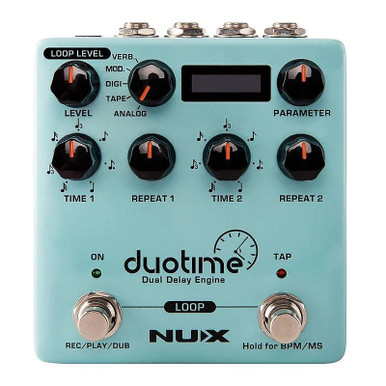
NUX NDD-6 Duo Time Delay Dual Pedal

£115.99

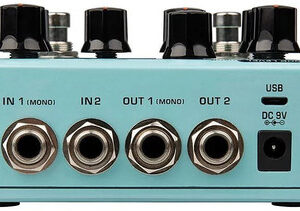
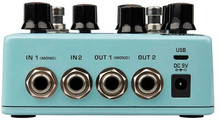
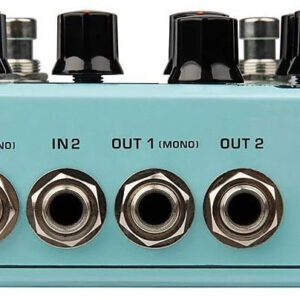
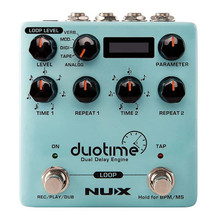
This is a New NUX NDD-6 Duo Time Delay Dual Pedal from NUX, listed in Delay Pedals on Just Pedals. Read More below.

View Just
more
and , ,

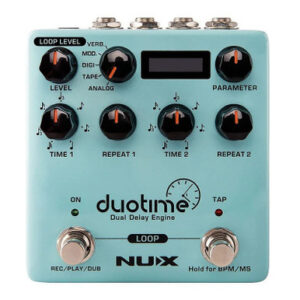
Duotime is a stereo delay pedal with independent time / sub-division & repeat knobs. In the 80's, professional musicians often used rack-mount effects to run stereo delay. It was the golden era of legendary engineering like Lexicon Delta, TC 2290, Eventide H3000, and more.

When Nux talked to "working musicians" they found that they were looking for a great stereo delay with a compact size and ultra-simple controls. The resulting unit from Nux encompasses all the essential requirements in the form of the Duotime Dual Delay Engine.

Key Features

  • Analogue Delay – Based on the bucket-brigade device (BBD), discrete-time analog delay. The PARAMETER tweaks your modulation depth. When LEVEL and REPEAT are at maximum, turn down the TIME KNOB to zero, and experience the natural infinite feedback of the old school BBD delay.
  • Tape Echo – (55ms~552ms) is based on RE-201 Tape Echo algorithm with NUX Core Image Technology. Use the PARAMETER to tweak the Saturation, and feel the distorted sound decay. Just like the real tape echo machine, when you adjust LEVEL and REPEAT to maximum, try adjusting the time knob down to zero, and you have infinite feedback and pitch shift flange.
  • Digi Delay – (80ms~1000ms) is based on the modern digital delay algorithm with magic compression and filter. After reviewing decades of delay algorithm evolution, Nux noticed musicians were not satisfied with the mathematical digital delay sound. So, they added a bit of non-digital flavour—inspired by Strymon and Neunaber making the sound much more musical. PARAMETER controls the hardness of the repeat signals, so you can feel the unique compressed filter.
  • Mod Delay – (20ms~1499ms) is based on the Ibanez DML algorithm; a weird and wonderful modulation delay. Nux selected the most wonderful aspects highlighting the musical time sync modulation rate offering a simple, seamless romantic tone.
  • Verb Delay – (80ms~1000ms) is the way to make your delay sound 3 dimensional. Similar to Nux’s Atlantic Delay & Reverb, they added Shimmer into the Plate reverb algorithm. Inspired by Kit Tang, the famous Hong Kong studio guitarist, Jamtrackcentral artist, a master of different reverb parallels with different frequency bands adding to his effect to achieve an authentic, 3-dimensional sound. PARAMETER controls the Plate reverb and shimmer mix.

Specifications

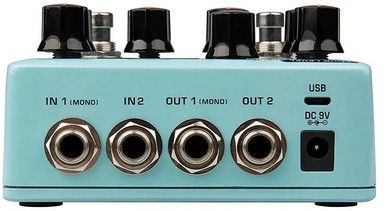
  • Delay Types: 5
  • Controls: Loop Level, Parameter, Time 1, Repeat 1, Time 2, Repeat 2, Delay Type
  • Footswitches: Rec/Play/Dub and Hold for BPM/MS
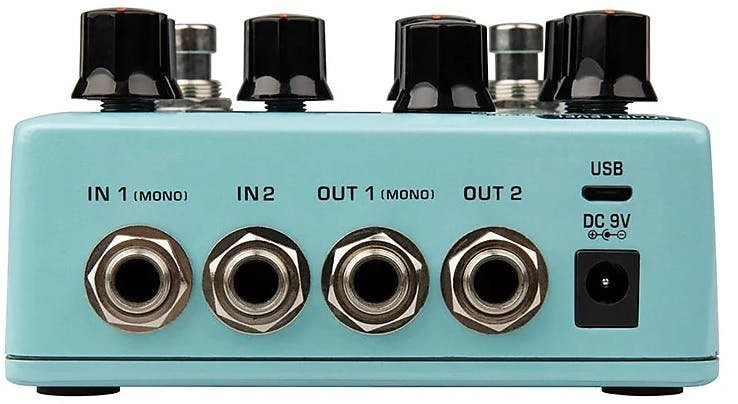
  • Power: 9V DC Adaptor (Not Included)
  • Dimensions: 105 x 115 x 58mm
Related videos

Brand

NUX

In the current JustPedals catalogue, NUX is represented by Multi-Effects Pedals, Overdrive Pedals and Delay Pedals. Current listings include Analog Delay, Plexi Crunch and Analog Chorus. That makes the range relevant to players looking for drive, gain and clipping, plus time-based effects and ambience. Check each model for its exact circuit or processing platform, controls, power requirements and connections, particularly where the catalogue includes both pedals and supporting gear.

Category

Delay Pedals

Delay pedals repeat the input after a set time, from a short slapback to long ambient trails. Feedback controls how many repeats continue; filtering, modulation, saturation and mix shape their tone and prominence. Tap tempo can keep rhythmic delays aligned with a song, while presets and MIDI help when several timings are needed. Analogue, tape-style and digital designs respond differently to transients and overload. Check maximum delay time, spillover, stereo routing, trails and headroom before choosing a model for the rest of the board.

Tags

Analogue

Analogue products use continuous audio circuitry for some or all of the signal path, so clipping, filtering or modulation arises from physical components rather than sampled algorithms. The label does not guarantee a particular tone; component choice, headroom, bias, noise and the surrounding gain stages still matter. Check whether the switching, presets, control section or cabinet stage is digital when the exact signal path is important.

Digital

Digital products use conversion and processing to create, store or control the effect. This can provide presets, complex routing, repeatable algorithms, USB, MIDI and firmware features, but conversion, latency, power requirements and clocking depend on the design. Check the input and output levels, sample or impulse-response support, bypass behaviour and current draw when combining a digital unit with analogue pedals or a direct recording setup.

Stereo

Stereo products provide separate left and right audio paths, which may widen modulation, preserve independent delays or route a pedalboard into two amplifiers or a mixer. Input and output behaviour is not always symmetrical: some units sum a stereo input, while others create stereo from a mono source. Check whether the effect collapses safely to mono, how the dry signal is routed, the socket format and the destination’s panning and phase requirements.