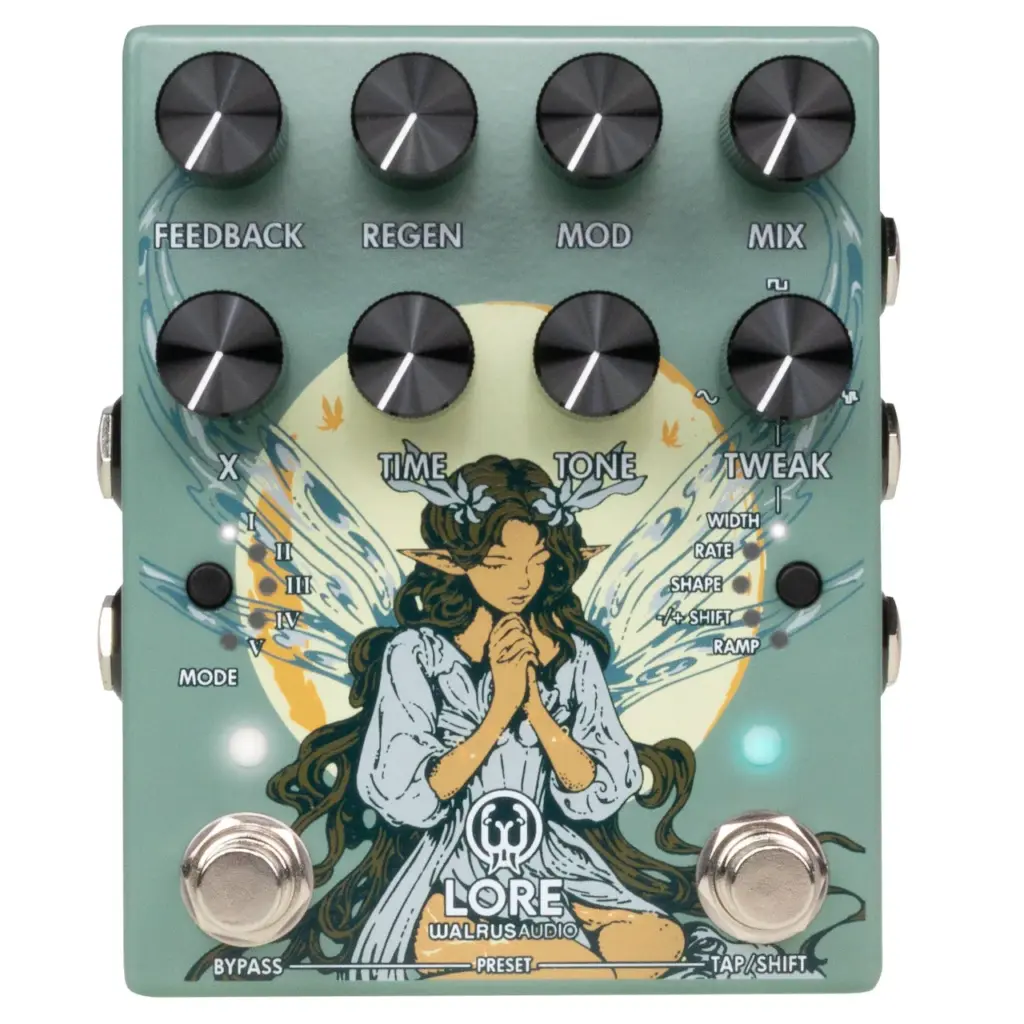
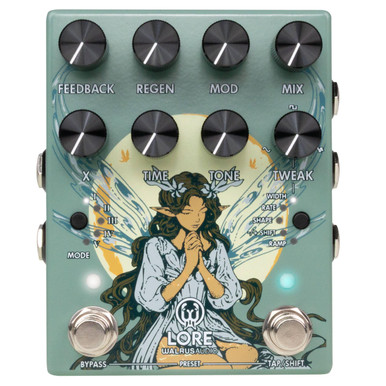



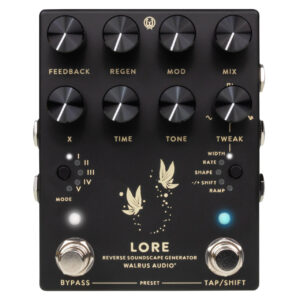
Create the soundtrack to your own storybook adventure with the Walrus Audio Lore MKII Reverse Soundscape Generator. This powerful stereo ambience pedal weaves reverse delay, lush reverbs and musical pitch shifting into five inspiring modes, letting you move effortlessly from delicate shimmer and dreamy swells to dark, cinematic pads and evolving pitch sequences. Now updated with stereo operation and full MIDI control, Lore MKII is built on Walrus Audio’s in-house MDSP platform for pristine sound and deep creative potential on stage and in the studio. With three onboard presets, 127 MIDI-accessible memories, tap tempo, expression control and a clever Dive / Rise momentary effect, Lore MKII is designed to slot straight into modern pedalboards. Run it mono in and stereo out to make a single guitar sound enormous, or place it at the end of a stereo rig for immersive, album-ready soundscapes. Whether you are scoring, worshipping, shoegazing or just getting lost in ambient textures, Lore MKII gives you a huge palette of reverse and pitch-based atmospheres in one compact box. Five Immersive Reverse and Pitch Modes Lore MKII offers five carefully voiced dual-effect algorithms that go far beyond a standard delay or reverb. Each mode pairs two effects with their own feedback paths, so your sound keeps evolving instead of simply repeating. From reverse delay into reverse reverb for eerie swells, to octave-up shimmer, octave-down gloom, dual reverb pads and duelling pitch delays that behave like a sequencer, Lore MKII is a one-pedal toolkit for ambient exploration. Stereo, MIDI and Deep Control Answering long-standing requests from players, Lore MKII adds full stereo inputs and outputs plus comprehensive MIDI. You can sync to MIDI clock, recall up to 127 presets, and control every knob and function via MIDI CC. An assignable expression input lets you morph any parameter in real time, or repurpose the jack as an external tap tempo, giving you flexible control for live performance and studio automation. MDSP Processing for High-Fidelity Soundscapes At the heart of Lore MKII is Walrus Audio’s proprietary MDSP digital processing platform, designed in-house for high headroom, clarity and the power needed for complex nested feedback paths. This ensures that even the most extreme time-stretching, pitch shifting and modulation remains detailed and musical, giving you inspiring textures that sit beautifully in a mix. Tweak, Dive / Rise and Presets for Performance The Tweak system puts five powerful secondary parameters under a single knob, letting you adjust stereo width, modulation rate and shape, Dive / Rise shift amount and ramp time without menu diving. Hold the tap footswitch to trigger the Dive / Rise momentary effect, bending the pedal’s internal clock for dramatic pitch and time sweeps. With three colour-coded presets plus a live mode on the pedal itself, you can keep your favourite soundscapes ready to go and still have room to experiment. Key Features Five Reverse and Pitch Soundscape Modes – Reverse delay, reverse reverb and pitch shifting are combined in five dual-effect algorithms, giving you everything from shimmering octave-up ambience and murky octave-down drones to evolving pads and rhythmic pitch sequences, all in one pedal. Stereo Operation with MIDI Control – Dual inputs and outputs let you run full stereo or mono in to stereo out, while MIDI clock and full MIDI CC control make it easy to integrate Lore MKII into advanced pedalboards, DAW-based rigs and live playback systems. MDSP Processing Platform – Built on Walrus Audio’s in-house MDSP engine, Lore MKII delivers clear, detailed sound and the processing power required for complex feedback networks, time stretching and modulation, so your most adventurous textures stay musical and inspiring. Presets, Expression and Dive / Rise – Store three presets on the pedal and up to 127 via MIDI, assign any control to an expression pedal for fluid real-time c…



Walrus Audio Lore MKII Reverse Soundscape Generator FX Pedal in Green
This is a New Walrus Audio Lore MKII Reverse Soundscape Generator FX Pedal in Green from Walrus Audio its found in our Specialist Effects Pedals on the Just Pedals menu. Read More below.
As an affiliate partner, we may earn a small commission when you buy through our links — at no extra cost to you.
Related videos

Brand
Walrus Audio
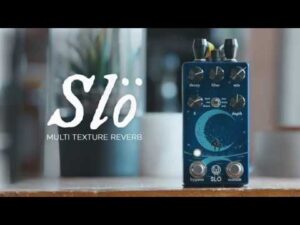
Walrus Audio describes itself as a collective of artists, musicians and engineers, bringing circuit design together with distinctive pedal artwork. The company says its effects are hand-built and manufactured in the USA. JustPedals listings illustrate the variety: ARP-87 multi-function delay, Slö ambient reverb, Julia analog chorus and vibrato, and Polychrome flanger. Some models focus on direct, compact controls, while others provide broader modulation or atmospheric textures. Compare each model’s modes, stereo connections and control options; the artwork is a signature of the brand, while the circuit determines how it fits a rig.
Category
Specialist Effects Pedals
Specialist effects alter the signal in ways that do not sit cleanly inside one established family. They may use granular processing, frequency shifting, resonators, freeze or sustain, bit reduction, ring modulation, feedback networks or combinations of several techniques. The relevant distinction is the underlying process, its tracking or latency, and how completely the dry signal can be blended or replaced.
Tags
MIDI
Sends, receives or responds to Musical Instrument Digital Interface messages rather than carrying the instrument audio itself. Program changes recall presets, continuous controllers move parameters, and MIDI clock or transport messages synchronise timing between devices.
Presets
Stores complete groups of parameter values for later recall. The number of locations, switching time, spillover behaviour and whether presets include routing, expression and MIDI assignments determine how completely one sound can change into another.
Stereo
Processes, creates or passes two audio channels. True stereo preserves separate left and right inputs, while mono-to-stereo effects generate spatial differences internally; routing, phase behaviour and whether trails remain stereo determine the resulting image. Some outputs sum to mono when only one socket is connected, which can change level or modulation depth.
Tap Tempo
Measures repeated foot taps and converts their interval into an effect rate or delay time. Subdivisions translate that pulse into dotted, triplet or other rhythmic values, while averaging and range limits influence how quickly and accurately the tempo settles.
Others Just Ordered :
- I Love A Happy Accident… – Animals Pedal

- Animals Pedal Vintage Van Driving is Very Fun Overdrive
- Animals Pedal Sunday Afternoon Is Infinity Bender

- Ninevolt Pedals | Bath Time Reverb (Animals Pedal)
- This Fuzz Pedal Makes No Sense… But It Sounds Incredible

- ANIME Pedals | Animals Pedal Custom Illustrated Series