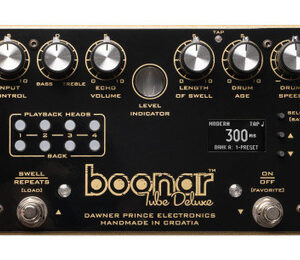
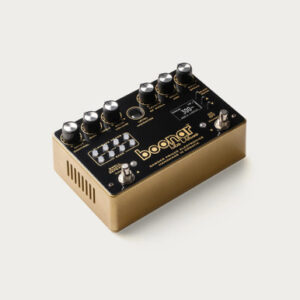

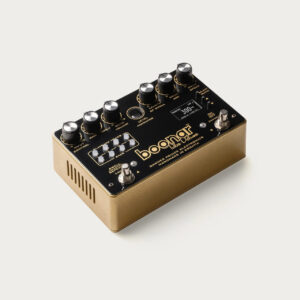
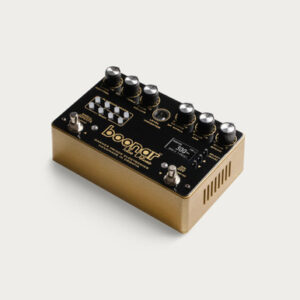
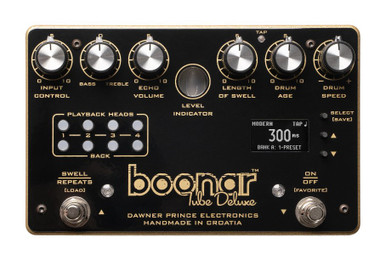
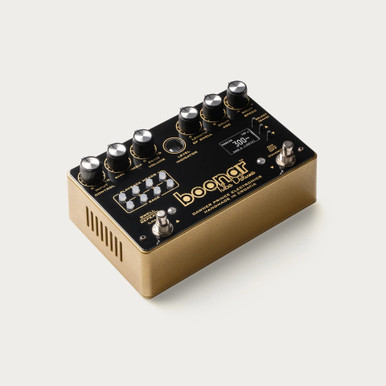
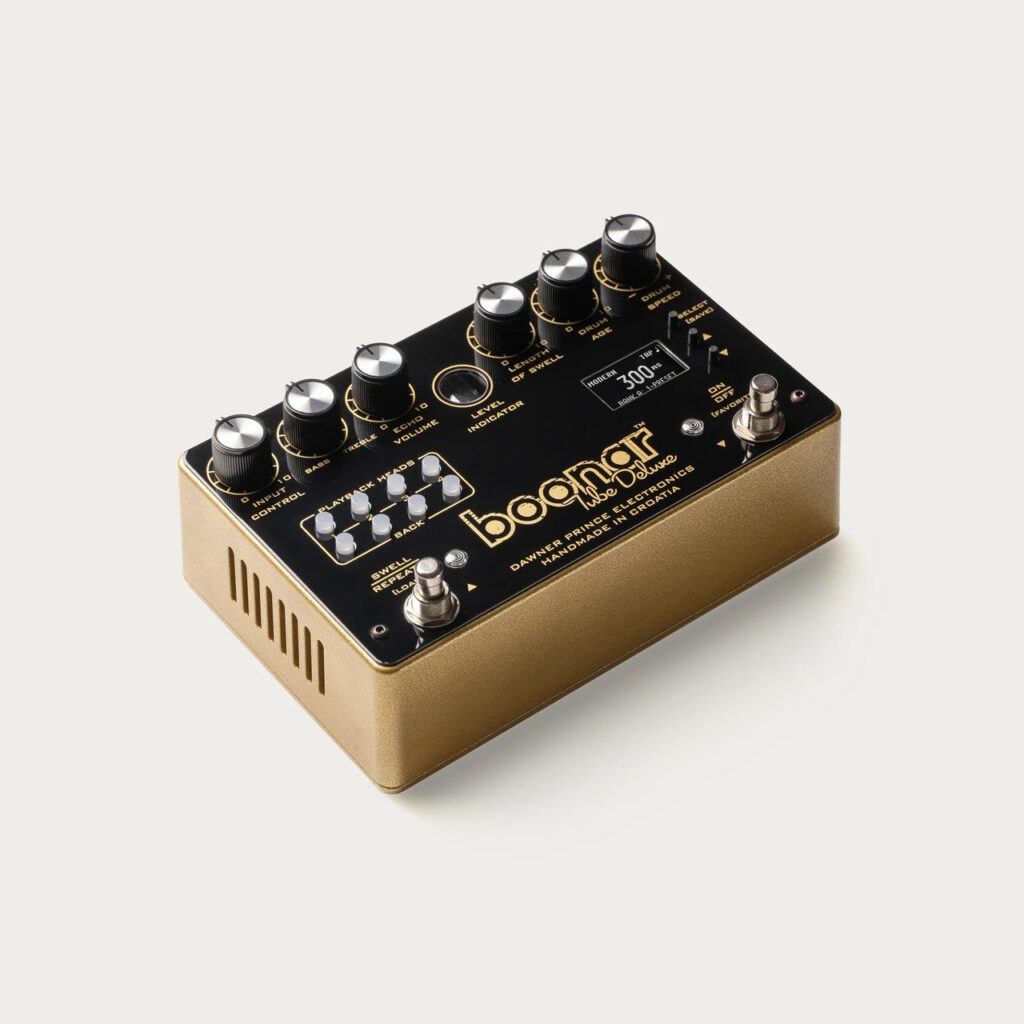
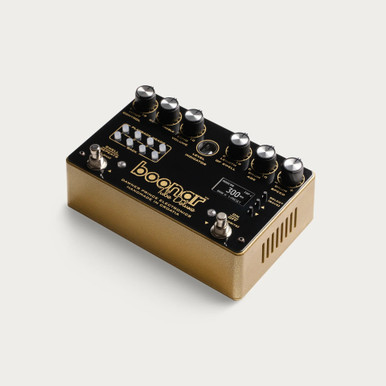
The iconic Binson Echorec 2 Model T7E Echo Machine has been faithfully replicated in a luxury studio-grade pedal format. Control the speed of the drum echo with the included remote.
This pedal has been carefully engineered with the highest quality components to bring back legendary vintage echo to let you fully explore its tonal possibilities.
Key Features
- Input Control – This control enables the Boonar Tube Deluxe to accept all kinds of instruments with various signal levels on the input.
- Integration with Modern Technology – The Boonar Deluxe has a balanced and transformer-isolated DI wet output for the seamless integration with studio mixing desks and external recording equipment.
- Fully Customisable – By using the onboard presets, an external tap tempo input, remote switching and expression pedal compatibility, along with full MIDI integration, customization is simple.
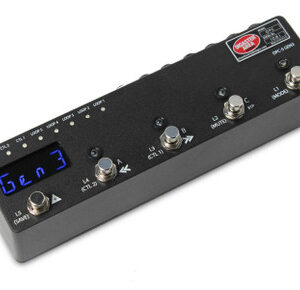
- Remote Controlled – Control the clicker speed with the included remote
- True Bypass – This pedal can be switched from true bypass or buffered bypass for full pedalboard flexibility. In Buffer mode, you can choose whether to create delay trails or not!
- MIDI Controllable – Control individual parameters, control knobs and more with MIDI control.
- Update with USB – USB mini-B connector is used for any future firmware updates.
Originally manufactured during the 1970s, The Boonar Tube Deluxe replicates the Binson Echorec 2 model T7E, famous for its magical four-tap tube magnetic echo which is heard on the legendary Pink Floyd songs “Interstellar Overdrive”, “Astronomy Domine”, “Shine On You Crazy Diamond” and “Time”.
Building upon the legacy of its predecessor, the original Boonar, this deluxe version represents a leap forward in vintage echo emulation technology.
Immerse yourself in the authentic original Binson Echorec tone and experience the nostalgic echoes of yesteryears, all without the hassle of mechanical maintenance.
Controls and Tonal Exploration
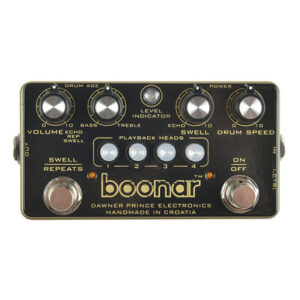
Create tonal possibilities of the yesteryear with controls such as echo Volume, length of swell & even how the drum operates by setting the drum age and speed which adds sweet characteristics which is what the original Binson was known so iconically for.
Playback Head Combinations
The original Binson Echorec had a 12-position rotational switch that enabled selection of different playback heads and combinations for single and multi-tap delay. We wanted to overcome that limitation and added a separate playback heads switches for a maximum of 16 possible head combinations.
Tap Tempo LED
When Clicker switcher is connected to the pedal and “tap tempo switch” selected in Global settings menu, the TAP LED light will flash in tempo with the global delay time.
Swell/Repeats
Switches between standard Repeats mode – Multiple repetitions depending on the Length of Swell control potentiometer and a Swell mode which puts a part of signal from all four playback heads into the output mixer to produce those reverb-like, “cathedral tone” effects
External In – Why Not Control With An Expression Pedal?
The remote jack serves double duty as either an expression pedal input or remote footswitch input. There are four modes of operation to choose from in Global Settings menu: “Expression pedal”, “Tap Tempo switch”, “Repeats/Swell switch“ and “Bypass Switch“ mode.
MIDI Control
By using the fully-featured 5-pin DIN MIDI input, this provides support for receiving MIDI PC messages to save and recall up to 127 presets. Use MIDI CC messages to control the individual parameters of Boonar Tube Deluxe including all knobs, switches and buttons and MIDI Clock to sync the delay time with an external MIDI Clock source.
Specifications
- Input impedance: 1M Ω / 47K Ω (selectable)
- Output impedance: 100 Ω
- Direct out: 600 Ω balanced and transformer isolated
- ADC / DAC resolution: 24-bit
- Power requirements: 12V DC / 800 mA (noiseless power adapter provided)
- Power supply connector type: barrel, 5.5mm * 2.1 mm, center-negative
- Size: 185 mm / 7.28 inch x 120 mm / 4.72 inch x 57 mm / 2.12 inch
- Clicker remote controller included