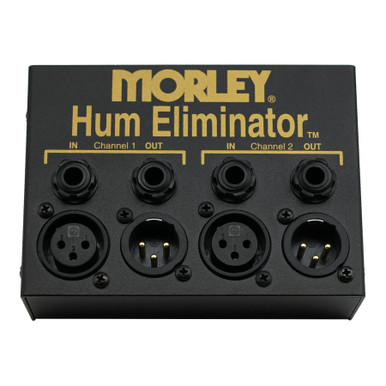
Here's what Morley says about the Hum Eliminator:
The Hum Eliminator uses our custom in-house made isolation transformers to break loop antennas that cause ground hum and buzz. Hum Eliminator also converts back and forth between balanced and unbalanced connections and prevents the cable to act as an antenna for noise.
Simply place a channel of the Hum Eliminator on the cable connections between the two offending pieces of equipment. Hum Eliminator will not affect the quality of the audio, it will improve it.
We use 1/4″ smart jacks that accept any combination of unbalanced (TS) or unbalanced (TRS) plugs. These are passive devices (no power required), in cold rolled steel housings, hand-soldered circuit boards and top quality components and hardware.
Specifications
- 2-Channel Hum Eliminator
- 1/4″ Smart Jacks and XLR Jacks
- Dimensions: 4.75″ (L) / 3.25″ (W) / 1.75″ (H)
- Prevents Ground Loops That Create Hum and Buzz
- Custom Morley Isolation Transformers
- Converts Back and Forth Between Unbalanced and Balanced Cable Types
- Simply Insert on Audio Connections Between Offending Pieces of Gear
- Not Intended for Use on Mic Level, Instrument or Powered Speaker Line