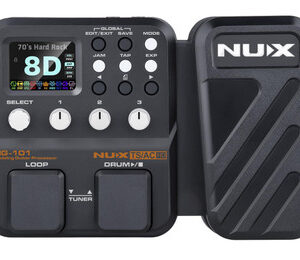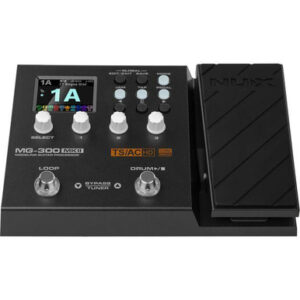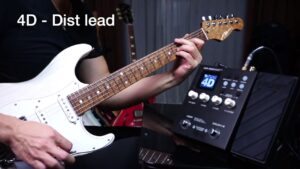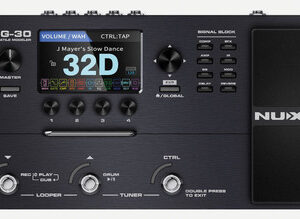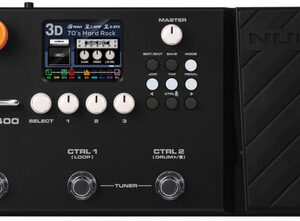
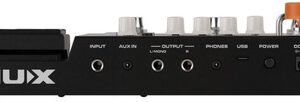
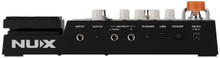

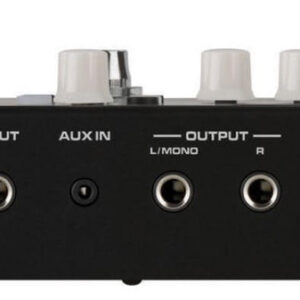
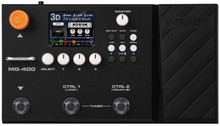
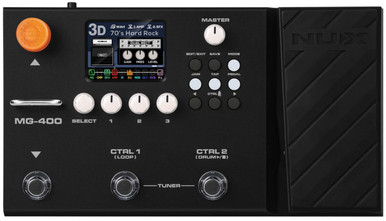
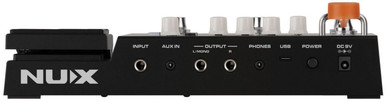
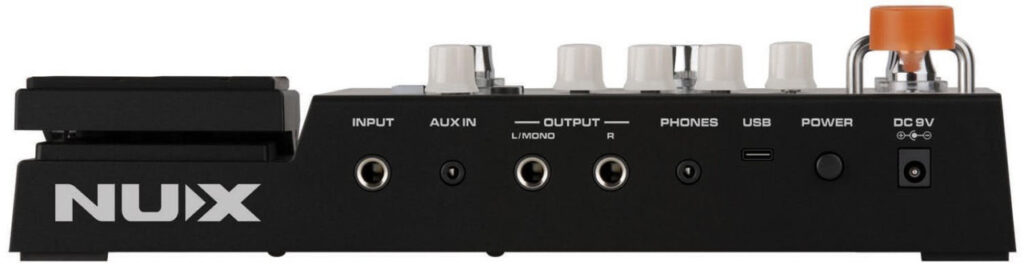
The NUX MG-400 is a value packed modeller akin to his little brother, the MG-300. MG-400 houses 2 powerful DSP chips for high-definition White-Box Amp Modelling algorithm (TS/AC-HD) and Core-Image post-effects. Since releasing the MG-300, people have been blown away by the sound and playability, not to mention the ease-of-use tone tweaking and intuitive interface.
Now, the MG-400 builds upon the MG-300 feature set moveable signal blocks, 12 IR Collection slots, flexible P.L block with Min & Max parameter setup, abundant System Menu, and physical Master volume knob, MG-400 is a great value modeller for the money.
Key Features
- White-Box Amp Modelling – The White-box Amp Modelling & Pre-EFX algorithm offers realistic playability and analogue-chaos response. The concept of “Chaos makes the muse” perfectly applies to the analogue circuit. When you tweak the knob, it affects itself as well as other parameters. For a linear digital system, the parameter is independent. The white-box algorithm offers real-time feedback, increment-by-increment. NUX TS/AC-HD replicates the same playability most guitarists crave in a real tube amplifier.
- Impulse Response – The MG-400 includes multiple impulse response of 512 samples each. You can load 3rd party IR files using our NUX QuickTone edit software (support up to 48kHz sample rate). The included 25 guitar cabinet IRs combine 4 classic microphones with 3 mic positions to allow beginners a quick and easy way to jump into the multi effects experience. Also included are 8 bass cabinet IRs and 3 acoustic guitar IRs, giving you the ability to play bass guitar on MG-400 or use electric guitar to simulate acoustic guitar sound with acoustic guitar IRs.
- 10 Independent Flexible Blocks – You can move signal blocks freely on the MG-400 and/or QuickTone editing software. Set the Patch Level block in front of Amp to swell the volume. Put Delay block in front of gain stage to create grooving riffs. There are lots of tone creations with the flexible block routing.
- 2.8” Colour LCD Display – Intuitive 2.8” 320*240 colour LCD with intuitive UI.
- Drum & Looper – The MG-400 supports NUX Phrase Loop Synchronization with Rhythm. You can play the rhythm then record your phrase loop. MG-400 will automatically beat match the phrase to fit the current rhythm BPM.
- USB Audio Interface – For home studio and silent practice, the MG-400’s USB audio capabilities makes it the Swiss Army Knife of guitar audio interfaces. Connect it via USB to your PC, and you can record tracks, reamp, and even livestreaming with the MG-400.
Specifications
- Controls: Select, 1, 2, 3, Master
- Push Buttons: Edit/Exit, Save, Mode, Jam, Tap, Pedal, Up, CTRL, Down
- Speaker Simulation: 25 Guitar Amps, 25 Cabinets, 4 Microphones and IR loader
- Switch: On/Off
- Expression Pedal: Yes
- Display: 2.8” Colour LCD
- Footswitches: 3
- Power: 9-12V DC Mains Adapter (Included)
- Dimensions: 289 x 160 x 71mm