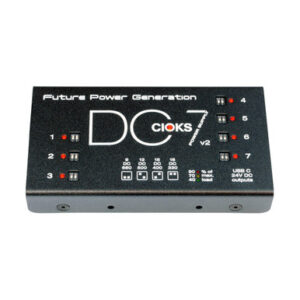
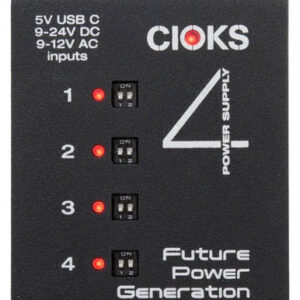
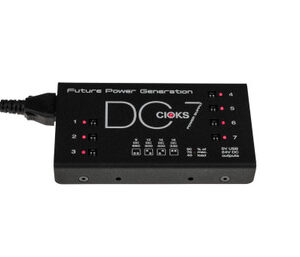
The CIOKS DC7 v2 Isolated Pedalboard Power Supply is a compact versatile solution for powering effects pedals with clean reliable DC power. Featuring seven individually isolated outputs with selectable voltages and an upgraded USB-C port it accommodates everything from traditional analogue stompboxes to demanding digital effects processors. Building on the award-winning original DC7 the v2 introduces a 5V USB-C output delivering up to 3A (15W) alongside improved efficiency for cooler operation. Its slim design fits neatly beneath pedalboards while compatibility with CIOKS expansion units makes it easy to accommodate growing effects setups.
CIOKS DC7 v2 Isolated Pedalboard Power Supply
£239.00
This is a New CIOKS DC7 v2 Isolated Pedalboard Power Supply from Cioks its found in our Pedalboards on the Just Pedals menu. Read More below.
View Just Cioks
As an affiliate partner, we may earn a small commission when you buy through our links — at no extra cost to you.
Related videos



Brand
Cioks
CIOKS is a Danish company founded by Poul Ciok in 1991, with a catalogue devoted to power for effects pedals. Its early five-output Baby supply established the focus on dependable pedalboard power; the current range adds low-profile isolated supplies and modular expanders. JustPedals listings include DC7, CIOKS 4, SOL and CRUX, plus mounting brackets and accessories. DC7 can power a range of analogue and high-current digital devices and expand through additional units, so outlet isolation, current draw and voltage options are the useful comparison points. CIOKS documentation says DC7 is designed in Denmark and assembled in Poland; that detail applies to DC7, not every product.
Category
Pedalboards
A pedalboard provides a stable surface and cable space for arranging effects as one transportable signal system. Rail spacing, usable area and mounting method determine which enclosures fit, while underside clearance controls power-supply and cable placement. Case type, weight, handles, risers, patch bays and removable sections affect protection and access without changing the audio signal itself.
Tags
Analogue
The signal is shaped by continuously varying electronic circuitry rather than being converted into a digital effect algorithm. Component choice, operating voltage and circuit tolerances influence headroom, noise, clipping texture and the small variations in response between designs.
Digital
Converts the signal or control process into numerical data for algorithmic processing. Digital designs can provide precise timing, long memory, complex routing and repeatable presets; sample rate, conversion, internal resolution and latency influence fidelity and response.
USB
Provides a Universal Serial Bus connection for power, audio, MIDI, firmware or editing data. The supported USB class and connector do not by themselves show its purpose; channel count, sample format, host compatibility and power demand define the actual function.